

The Commonwealth corruption conference and anti-corruption summit in London last week saw the full engagement of civil society. Leaders from big household name NGOs were active online and in person, taking the opportunity to challenge a range of related injustices. It was exciting and encouraging, but these events should prompt those NGOs to ask themselves, ‘how effective are our own organisational counter-fraud and corruption frameworks?’ If the question needed underlining, we also learned that the US government is investigating allegations of corruption affecting NGOs in the Syria emergency response.

What Boards need to do in order to reduce fraud and corruption risk is well-trodden ground. But for international NGOs, one of the great challenges can, in fact, be the Board. As your organisation’s counter-fraud lead, what do you do if members of your Board don’t recognise that fraud and corruption is a problem? Or merely give it lip service, unwilling to invest in meaningful risk reduction efforts? Or worse, are content to turn a blind eye to the risk of physical assets, funds and stock falling into the wrong hands if most aid gets through?
Obtaining the buy-in of an NGO’s Board isn’t about selling them a product – we need their ongoing support and ownership. It’s about changing perspectives; a long haul, not a quick win. So, in helping to generate that ongoing support, I’ve found that these tips (which are not exhaustive and in no particular order) have assisted my colleagues and I; perhaps they might help you too.
1. Educate to effectuate
 Fraud and corruption has, historically, not been well understood in this sector. Your Board may have a low or rudimentary understanding of the risk and how to respond to it. This means starting at a basic level, making no assumptions, taking the time to address myths and misconceptions and playing a longer game. ‘Educate as you go,’ Willie Oelofse from Deloitte Kenya told NGOs at a conference in January. As we do so, of course, it’s important to remember that counter-fraud is a good news topic – your organisation may be at high risk, but actually there’s a lot that can be done to reduce it. Boardrooms are learning environments too.
2. Keep it simple

Board members are busy. NGOs (especially humanitarian agencies) are often very responsive, and Board members’ attention is divided between competing thematic risk areas and arising issues. Use your time with them wisely. Proposal documents and assessments, for example, should be short or with executive summaries. Don’t bury key messages in a risk assessment document the size of a telephone directory.
3. Speak from within
 Civil society is under attack the world over, and the issue of their fraud and corruption exposure can be something that sends Board members running for their shields and helmets – especially if it is perceived to come from an out-group rather than in-group. Take charge of how the matter is framed. Don’t let them entrench in defensive positions to ‘fend off’ your ‘attack,’ or sit in a ‘prospective client’ chair to listen to you ‘pitch’. Instead, use their business language, show your understanding of the difficulties they face, and speak from inside their group. Explain the landscape around them, and how you can help them navigate across it.
4. Remember that they’re individuals
 People make decisions differently and on the basis of different values. For example, I am a big fan of the MBTI, which is one of a range of models that can help us to understand how we like to work and how best to relate to others. Models like these can really help to improve workplace relationships. So try to understand each member of your Board as a person, and what really drives their decisions. Some will be persuaded by cold, hard data, others by less tangible matters such as how your agenda relates to values, supports people, and so on.
5. Bring the risk to life
 Fraud and corruption, especially at a strategic level, can be abstract concepts. Help the Board to connect by painting a picture of the risk with case studies. If you don’t have any in your own organisation, then perhaps partners, donors or other organisations have some they will let you use? If not, then find cases in the public space affecting comparable organisations. If you’re really struggling, consider using fictional examples – but remember to state that they’re fictional!
6. Show the benefits
 NGO Boards are often allergic to anything with a whiff of extra expense, especially if it is ‘overhead’ or ‘administration’ flavoured. So explain the benefits of the agenda not just in terms of what it prevents, but also what it gains – efficiency, effectiveness, quality improvement, and so on. Much of counter-fraud work synergises with good management (an example arises from the world of retail – smiling as a customer enters not only deters shoplifting by making the individual feel noticed, but is also good customer service!).
7. Take an evidence-based approach
 NGO Boards manage a lot of risks, only some of which materialize. Using evidence helps them to appreciate how fraud and corruption sits, whether that evidence is perception-based, representative sampled, or from other diverse sources. Cast the evidence net wide – consider staff surveys (especially anonymous surveys), risk assessments, project and programme evaluations, audit reports, security reports, academic research and open source. This may mean that you need to start by improving the detection of incidents, in order to gather enough material. Be cautious with the use of quantification estimates, as these can be inherently open to challenge by those feeling resistant, and with over-stating the case (being debunked seriously damages credibility). Remember to cater for any risks created by the counter-fraud agenda, and to consider any donor or legal obligations.
8. Align with organisational objectives and strategy
 Just as is the case with private and public sector organisations, the counter-fraud agenda needs to directly support the organisation’s mission. This needs to be clearly elucidated so that Boards can see that counter-fraud is a mainstream activity, rather than a distraction.
9. Obtain a sponsor
 In March’s Charity Finance magazine, I explained why fraud and corruption needs to be a standing priority for NGO Boards. But in addition to this, the counter-fraud agenda needs a champion at Board level. Benefits of this include how the champion can look out for synergies with other business areas as they’re discussed.
10. Put in the legwork
 A ten-minute agenda item at a Board meeting is not enough to ensure that a Board truly embraces counter-fraud and corruption. Obtain regular meetings with each member to explore their own position and build their buy-in – especially before key decisions are to be made. Similarly, the counter-fraud agenda needs to align not just to the organisation’s mission but to the agendas of those individual Board members. How does countering fraud help, not hinder, the aims of the person in front of you?
11. Bonus tip!
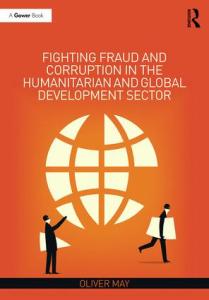
Why not get the members of your Board a copy of Fighting Fraud and Corruption in the Humanitarian and Global Development Sector? It explains the risk, busts myths and misconceptions, and sets out ways for NGOs to minimise the risk. It’s out now with by Routledge, pick up a hardback or e-reader copy via the Routledge website or Amazon!
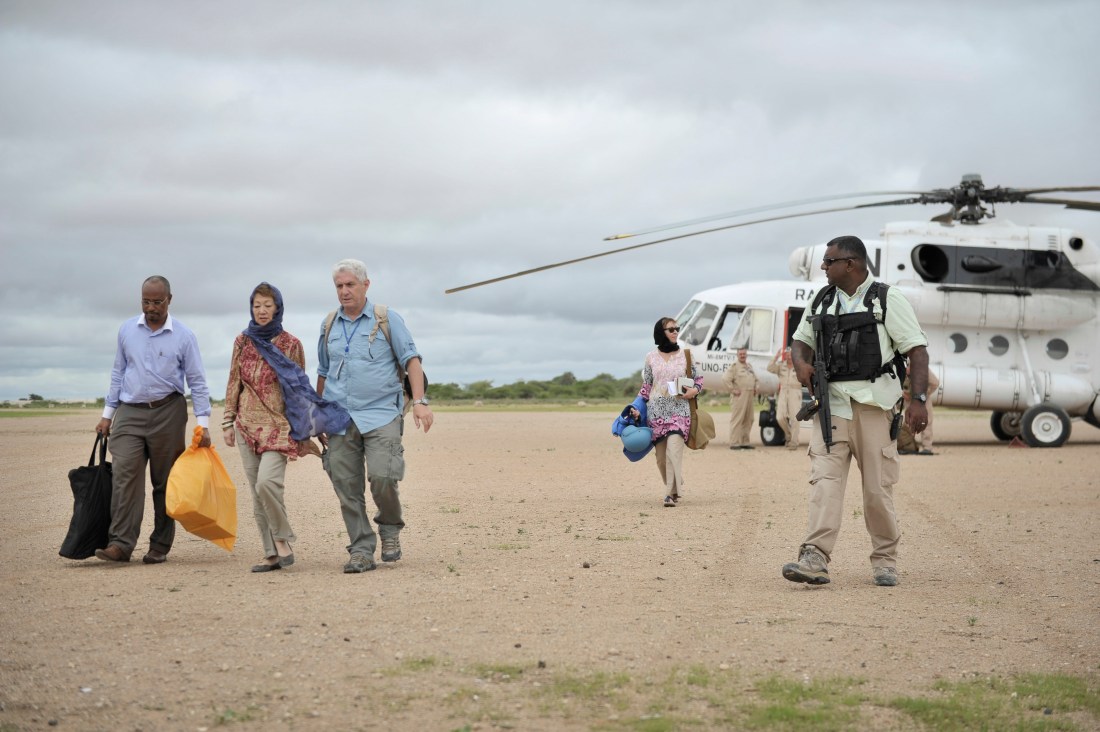
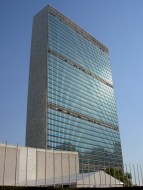 But there is a tension. Case studies such the UN’s experience in Somalia support a perception amongst many in the sector that, generally speaking, working with local partners represents an elevated fraud and corruption risk. A range of reasons are commonly cited for this, but the most common perhaps is where partners carry lower capacity and capability in finance and wider management by comparison to that of the international agencies, or donor expectations.
 The first is the very reason international agencies often work with them in the first place – they understand their local environment. They know where the risks are, and are in a strong position to evaluate how to reduce them. This can mean more informed planning (how long does it take to get that permit without paying a bribe?) and risk management, if the space is given to it.
 Whether in remote programme management or not, local partners are often physically closer to project delivery or able to more efficiently move around and interact. This is a substantial advantage for monitoring, and the detection of red flags.
 Development expert Jennifer Lentfer tells
  The global coverage of telecommunications is expanding as fast as its costs are declining, meaning that much humanitarian and development work is happens underneath its umbrella. This means that innovative software and hardware solutions to manage and monitor programming are increasingly available and affordable.
 There are corrupt local organisations out there, of course, who have the sole or corollary aim of gaining access for their principals to international agencies’ funds. But the vast majority of local organisations whom I have encountered have been full of passionate people doing amazing work in difficult circumstances. Robust selection processes are needed to ensure that these are the partners who are taken on.
 In 2010, there were a
  Research suggests that we feel losses more intensely than gains – so if you lost a £100,000 sports car, you’d feel that much more powerfully than you would if you won a £100,000 sports car in one of those airport car lotteries. This emphasis leads to an
 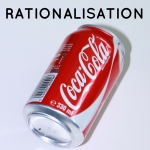 Celebrated psychologist Dan Ariely conducted an interesting experiment in which he placed dollar bills and cans of Coca-Cola around the campus of an American university. When he went back, the dollar bills were all still there – but the Coke cans had gone. (You can read about this, and other experiments, in his fantastic book
  When you’re driving, have you ever noticed that if someone else makes a mistake, then they’re an idiotic and dangerous driver – but if you make a mistake it’s because you were interrupted by a passenger, the car needs servicing, or you were responding to something another car was doing? This effect is known as the
  A few years ago, in a Middle Eastern country, I was delivering a workshop for managers on reducing fraud and corruption. A lady interrupted me to say, ‘but this is just the way things are here!’
 Second Marshmallow